This is the third and final part of our series to get you ready for the Super Bowl.
As mentioned before, this blog aims to give you a broad overview of the sport so you can join the conversation or at least understand what is happening on the field.
The Series So Far:
If this sparks even more interest or you find yourself becoming a fan through a better understanding of the game, there are plenty of blogs, podcasts, and creators out there to dive deeper. One thing is for sure: the football community is incredibly inclusive. And that doesn’t just apply to being a fan.
Could it be that American Football is one of the most inclusive sports? There’s a place for everyone here—whether you are tall, short, powerfully built, or lean. Every body type has a specific position. Again, a very “fair” aspect of this supposedly “unfair” sport.
In this third part, we want to cover the interesting details that round out your knowledge. Even if you don’t find the time to read this before Sunday, the first two parts are enough to hold your own at any party.
Back to the options that allow everyone to find their role. This is because there are many different positions, each with a very clear task—and different rules.
For comparison: In soccer, any player can score a goal, regardless of their position. In football, not every player is allowed to score a touchdown
—at least not by catching a pass. There are various exceptions that allow other positions to score.
For example, any defensive player can score if they win the ball (a turnover) and run it into the opponent’s end zone during the same play. But to keep it simple: There are only certain positions that are “eligible” to catch a pass and score that way.
Regardless, there is a position for everyone.
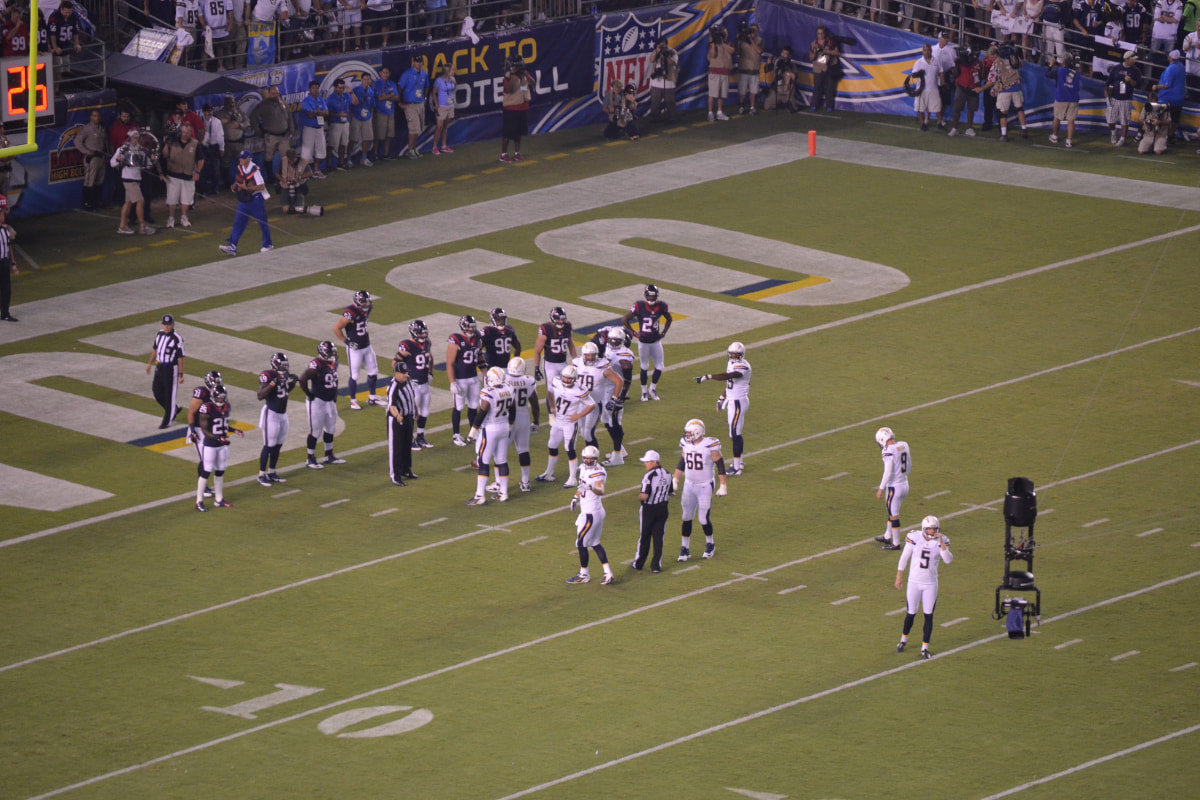
The big, heavy guys usually play directly opposite each other at the Line of Scrimmage. This is the virtual line where each play begins. Here you’ll find the players protecting the Quarterback (the Offensive Line—even taller and heavier) and the players trying to disrupt the play from the start (the Defensive Line—those on the ends attacking the Quarterback, and those in the middle trying to stop the Running Back).
If you are interested in the specific positions and their duties, feel free to check here: NFL: Player Positions.
Naturally, some positions are in the spotlight more than others. This is because there are more statistics and highlights to evaluate them. How many times a defender tackled the Quarterback is easier to see than how well the Quarterback was protected. Plus, caught balls and points scored are always highlight-reel material. But that doesn’t mean you can’t find a favorite player in a less prominent position. We always love it when the “big guys” get their moment in the spotlight!
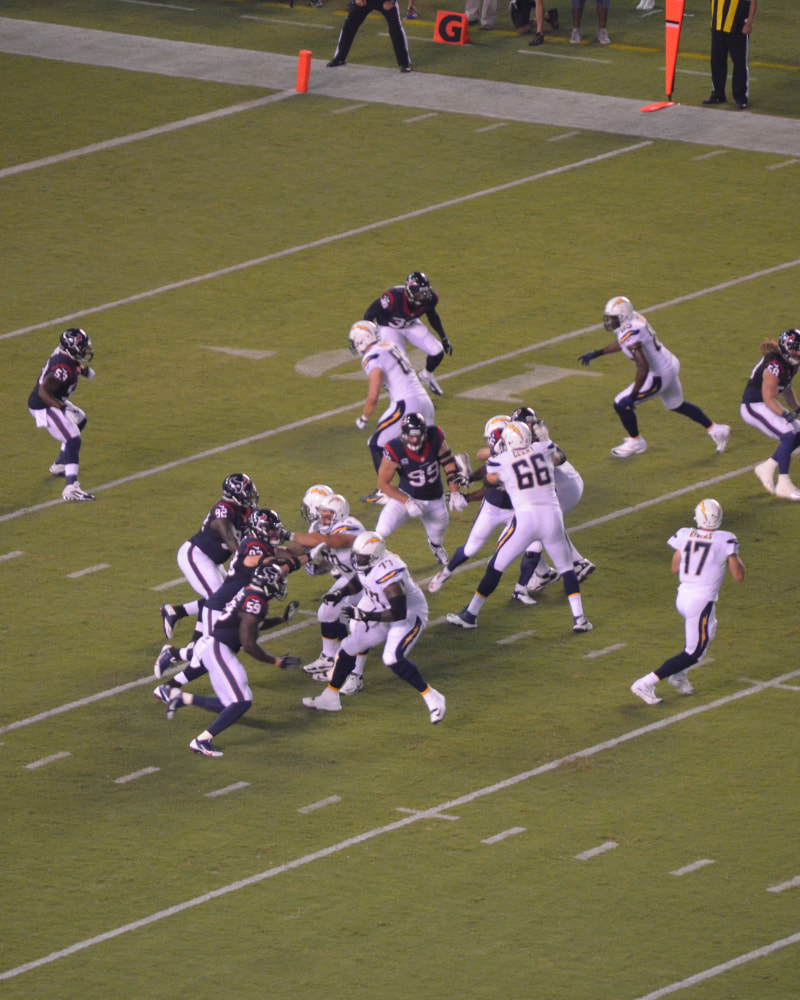
The spotlight is usually reserved for the Quarterback. A term everyone knows, and most people know he’s the one throwing the passes. But he does so much more. He has to execute the coach’s specific instructions—which he receives via a headset in his helmet—while simultaneously “reading” the defense, keeping an eye on everything, and instinctively trying to make the best play. He is the driving force of the offense, much like a conductor in an orchestra.
Without diminishing the art of the orchestra, it’s a comparison that shows how important every single player is. The players on the field must function as a complete unit. Everyone has a clear task that must be fulfilled; otherwise, the whole team is weakened. In an orchestra, it would also sound significantly worse if just one instrument was out of time.
The team consists of 54 players on game day, even though “only” 11 players are on the field per play, whether for offense or defense. Still, the sidelines are packed with players. This makes sense, as both the defense and offense have substitutes.
After all, a game consists of four 15-minute quarters. Short breaks occur between the 1st and 2nd, as well as the 3rd and 4th quarters. Between the 2nd and 3rd quarters, there is a long halftime break—and during the Super Bowl, this features THE Halftime Show. Because of this show, the Super Bowl lasts nearly four hours. A regular game usually takes a bit over three hours.
Why so long if only 60 minutes are played? In certain situations, the clock is stopped—for example, when possession changes or a team scores. Then there are timeouts to discuss tactics and, unfortunately, injury breaks. All in all, it’s a long game played in full gear, which explains the many players and frequent substitutions.
You often don’t even notice the substitutions because they happen between plays. The only major shift important for you to recognize is the switch from offense to defense. You’ll usually see a large group of players jogging onto the field at once. Also, in most cases, the ball is kicked with the foot beforehand—a clear sign that possession is changing.
But again, there are exceptions. If a team fails to gain 10 yards after four attempts, possession switches without a kick. Or if the defense steals the ball. We could write an entire post just on special rules, but that wouldn’t fit our mission. So, here is one last “treat” for you.
There are so-called Trick Plays, where a team tries to outsmart the opponent with unusual moves. These are rare but great to watch, especially when successful. A famous example is the Lateral (or backward pass). In Part 1, we mentioned that you can only pass once per play. That only applies to forward passes. Backward passes can be played as often as you like. This is rare, but occasionally plays incorporate one or two laterals. It doesn’t matter if a forward pass is played afterward or has already been played.
If you have questions about this or any other topic regarding the “pigskin,” just reach out to us through the usual channels. We’re happy to help—even during or after the Super Bowl if you notice something you’d like more info on.
Now, we wish you a lot of fun watching the Super Bowl. May you join the conversation with your new knowledge and (more importantly) truly understand the magic happening on the field!
At 49 Bills Drive, a Buffalo Bills fan shares his perspective on the NFL and his team. Easy to understand, free of overly technical jargon, but always full of joy and passion. He shares his football knowledge here on what the sports.