If you want to keep track of European basketball, you are quickly faced with a jumble of similar-sounding names: EuroLeague, EuroCup, Europe Cup – but they all actually refer to different competitions.
In this overview, you can find out which European basketball competitions there are, who is playing against whom and how the systems are connected.
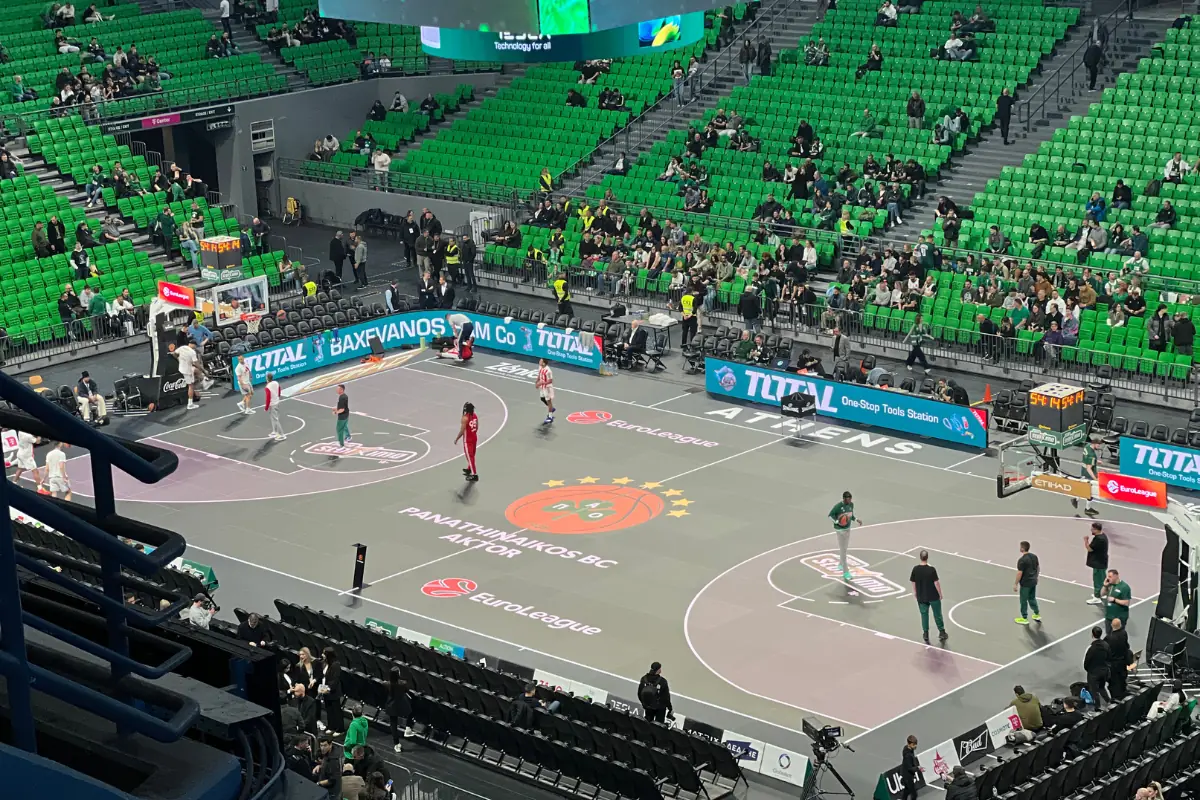
The EuroLeague is the greatest thing a European basketball club can achieve. Europe’s Champions League, if you like – but for basketball. Whoever plays here has really made it. Athletically, economically and also in terms of standing.
It is organized by Euroleague Basketball (ECA), a private company that operates completely independently of the official European basketball association FIBA.
In the 2025/26 season, 20 teams will play against each other for the first time. Each team will play against each other once, in a first and second round. That’s 38 match days in the regular season. Teams in first to sixth place in the table qualify directly for the playoffs at the end of the season. The teams in 7th to 10th place fight for the last two playoff tickets in a play-in tournament (based on the NBA model). Only then does the best-of-five playoff phase begin. The Final Four – the grand season finale – traditionally takes place on a single weekend in a selected host city.
One of the biggest criticisms of this competition is that the field of participants is a rather elitist society. The field of participants is made up of three pillars:
The EuroCup (currently called the BKT EuroCup for sponsorship reasons) is the direct substructure of the EuroLeague – and therefore the second most important club competition in Europe. It is therefore something like the second European league and is also organized by the ECA.
The competition also comprises 20 teams, which are divided into two groups of ten in the regular season. The format then differs significantly from the EuroLeague and ensures maximum knockout round drama: the first play-off rounds are played in a single, all-important knockout game (do-or-die). Only from the semi-finals onwards does the mode switch to a short, crisp best-of-three series. This makes the EuroCup extremely unpredictable and exciting.
Qualification takes place primarily via the national leagues: Those who finish high up in their home league (such as the German BBL) but do not have a permanent EuroLeague ticket can apply for the EuroCup.
For German clubs such as ratiopharm ulm and Hamburg Towers, the EuroCup is their permanent international home. Alba Berlin also plays here when there is no wildcard spot available in the EuroLeague.

Parallel to the private ECA world, a completely separate competition system of the official world federation FIBA Europe has existed since 2ß16. In theory, this is the first European league (of FIBA). However, in terms of image and sport, it can be classified as the third level of European basketball.
The BCL starts with 32 teams in the main round, which are divided into eight groups of four. After a classic group stage (first and second leg), the group winners advance directly to the round of 16, while the second and third-placed teams compete for the remaining places in a short “play-in” series. In a subsequent round of the last eight (again in groups of four or play-off series), the four best teams qualify for the big BCL Final Four, which crowns the champion over one weekend.
The big difference to the EuroLeague world is that the only thing that counts here is the principle of performance, i.e. you can qualify purely on a sporting basis – no matter how big or small the market behind it is.
The starting places are allocated strictly according to the placings in the national leagues of the previous season.
The BCL is a real success story for German teams. Telekom Baskets Bonn sensationally won the title in 2023. Teams such as MHP Riesen Ludwigsburg and Brose Bamberg have also played an important role here over the years.
Okay, the FIBA Europe Cup is once again theoretically the second European FIBA league. In the context of all four competitions, however, it is more the fourth tier. It is also organized by the official association and is directly below the Champions League. It serves as the perfect introductory stage for teams who want to get a taste of European competition and make a name for themselves internationally.
The format has a very classic and variable structure: After one or more qualifying rounds, the teams play against each other in a first and second group stage. Whoever comes out on top here moves on to the play-offs, which are played in the traditional European Cup format: There is a first leg and a second leg in the quarter-finals and semi-finals, and the title is also decided in the final over two games (total score).
This is where up-and-coming clubs meet teams from smaller European leagues: Clubs that narrowly failed to qualify for the Champions League are automatically allowed to continue playing in the Europe Cup. In addition, there are teams from strong leagues that have narrowly qualified for Europe via their national ranking.
The Niners Chemnitz, who sensationally won the FIBA Europe Cup in 2024 and used this title as a catalyst for their entire club success, proved just how strong this springboard is.
| Competition | Organizer | Level | Teams |
|---|---|---|---|
| EuroLeague | ECA (private) | 1 | 20 |
| EuroCup | ECA (private) | 2 | 20 |
| Champions League (BCL) | FIBA Europe | 3 | ~32 |
| Europe Cup | FIBA Europe | 4 | variable |
For a long time, the relationship between the private ECA and the international federation FIBA was characterized by an unpleasant, open conflict. As the EuroLeague was founded by the top European clubs themselves, it operated completely outside the FIBA framework for years.
The result was a logistical nightmare for the sport: match dates clashed directly with each other, players had to choose between their club (EuroLeague) and their national team (FIBA internationals) in the middle of the season. Not to mention the economic setbacks suffered by both leagues due to the competition. Associations, managers and leagues regularly argued publicly.
The picture has changed significantly since the 2023/24 season. FIBA and ECA agreed on a historic joint calendar arrangement. Overlaps between EuroLeague matchdays and the FIBA international match windows have been largely eliminated. Since then, professional players no longer have to choose between their employer and their home country – a milestone that was celebrated by players, coaches and fans alike. Since then, both organizations have been actively working on a lasting, harmonious solution for the future of the sport.