Cheerleading equipment

Pompoms in cheerleading: what are these colorful pom-poms for?

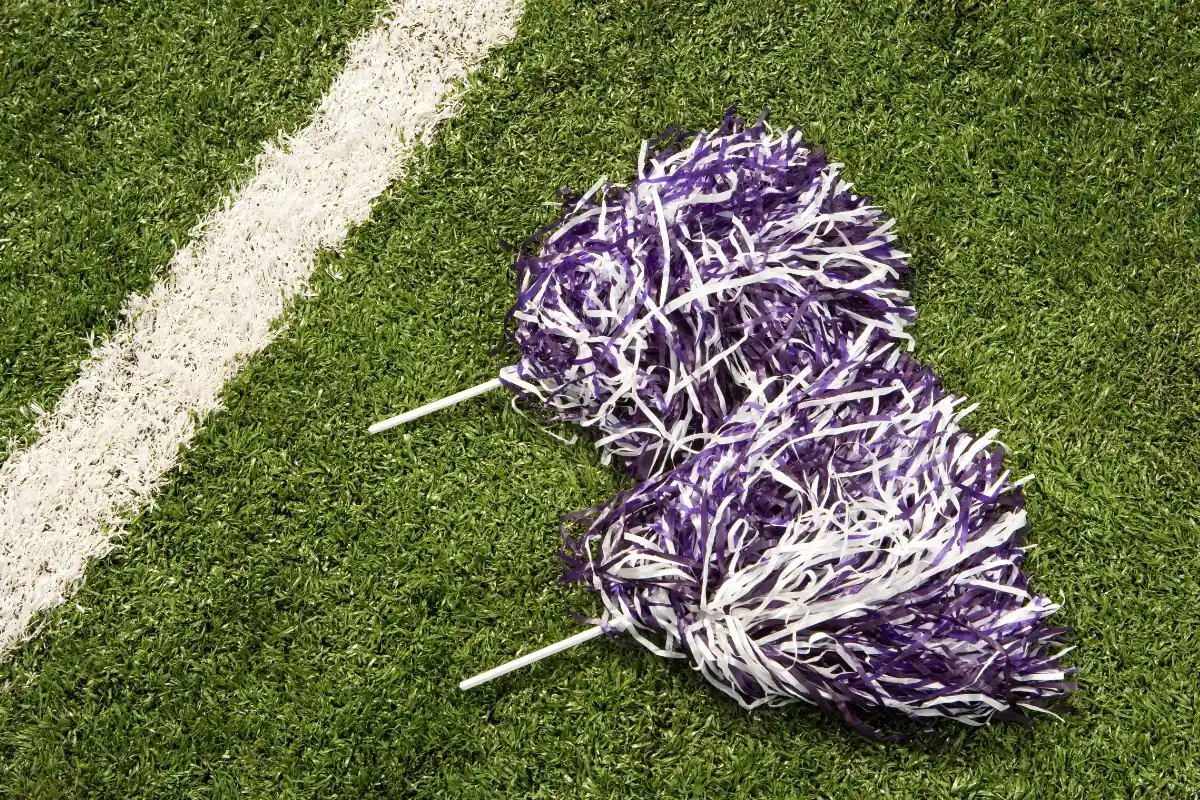
If you imagine a cheerleader, it’s guaranteed to be with colorful, glittering pompoms in her hands.

But did you know that pompoms aren’t just supposed to look good, they actually have a function?

Here you can find out everything there is to know about the best-known equipment in cheerleading.

What are pompoms really for?

Cheerleaders don’t just wiggle their pompoms around: they use them specifically to make their movements visible.

When a cheerleader makes an arm movement – a so-called motion – you can see it much more clearly when colorful pom-poms flutter at the end of the arms. They work like a visual amplifier of the choreography. Your gaze automatically follows the pompoms. This is also the reason why they are mainly used at the beginning of a routine or during a chant: The pom-poms tell the audience without words “Look now. It’s starting.” Attention is directed in a targeted manner.

But that’s not the only reason why cheerleaders use colorful pom-poms.

Pompoms are real sports equipment

Yes, admittedly: That sounds a bit strange at first. But there is an entire competition category that revolves exclusively around pompoms. In the so-called “Freestyle Pom”, pompoms are not just a small element or pure decoration, but really the entire piece of sports equipment.

Freestyle Pom is all about maximum synchronization and speed. Here too, the poms should visually reinforce the movements. Just not for a short chant, but for the entire routine.

Did you know that there are different types of pom-poms?

Here you can read more about the different types of pom-poms

Damit du verstehst was die Unterschiede sind, müssen wir uns ganz kurz anschauen, wie so ein Pompon überhaupt aufgebaut ist.

Die Puschel-Anatomie: Woraus besteht ein Pompon?

Jeder Cheer-Pompon besteht im Grunde aus zwei Elementen:

Der Griff: Er bestimmt, wie der Pompon gehalten wird, wie viel Kontrolle man bei schnellen Bewegungen (den sogenannten Motions) hat. Es gibt ganz klassische Griffe (wie ein einfacher, gerader Stab), die nur in der Handfläche aufliegen. Und es gibt Varianten, die aussehen wie ein kleiner Schlagring oder elastische Schlaufen (Loop oder Cheer Handles). Bei diesen verschränkst du deine Finger direkt im Griff, um maximale Kontrolle zu haben oder die Hände für Stunts und Würfe blitzschnell frei zu bekommen, ohne dass der Pompon auf den Boden fliegt.

Die Streamers: Das ist der Fachbegriff für die einzelnen Fransen oder Kunststoffstreifen. Sie machen die Bewegungen für das Publikum sichtbarer. Streamers gibt es in verschiedenen Längen, Breiten und Materialien – von klassisch matt über glänzend bis hin zu metallischen oder holografischen Effekten, die unter Scheinwerferlicht extrem reflektieren.

Und eben genau bei der Kombination aus Griff und Streamers trennt sich die Spreu vom Weizen. Die folgenden drei Typen solltest du kennen.

Die drei Pompon-Typen im Überblick

Dowel- oder Rooter-Pompons

Dowel-Pompons bestehen aus einem kurzen, stabilen Kunststoff- oder Holzstab, bei dem an einem Ende die Fransen befestigt sind (und folglich wie bei einem Wischmopp nur zu einer Seite abstehen). Du hältst den Dowel direkt an diesem Griff fest, dadurch ist er extrem einfach und sicher zu handhaben, auch unter Druck oder bei schweißtreibenden Choreografien. Deshalb sind Dowel-Pompons bei Anfänger-Teams, Schulen und im Training weit verbreitet.

Pompoms werden primär nach dem Griff unterschieden, daher können sie je nach Ausrüster auch etwas unterschiedliche Namen haben. Dowel-Pompons werden manchmal auch Kap- oder Peg Handle-Poms genannt. 

Optisch ist das die klassische Form, die du zum Beispiel auch von Faschings-Kostümen kennst. Im professionellen Cheerleading ist der Dowel-Pompon natürlich deutlich hochwertiger verarbeitet und hat viel mehr Fransen. 

Übrigens: Wenn wir von der ganz billigen Variante mit extrem wenig Fransen sprechen redet man im Fachjargon von Rooter Poms. Rooter Poms sind kein Sport-Equipment, sondern reine Fan-Giveaways oder eben Accessoires für Kostüme.

From crepe paper to plastic: how the pompom was created

Pompoms didn’t always exist. In the 1930s, cheerleading was actually just … shouting. Men shouting slogans and cheers from the sidelines. At some point, someone came up with the idea of making pom-poms out of crepe paper and swinging them while shouting. But the problem with paper pom-poms becomes apparent pretty quickly: after a routine, the shreds are everywhere.

In the 1950s, Lawrence Herkimer developed sturdier pompoms with a hidden handle. The real game changer came in the early 1960s with Fred Gastoff: vinyl streamers made of plastic. Robust, water-resistant – and with the advent of color television, suddenly a massive advantage. Colorful pompoms simply look better in color. And since then, pom-poms have been inextricably linked with cheerleading.

Leave a Reply

Your email address will not be published. Required fields are marked *