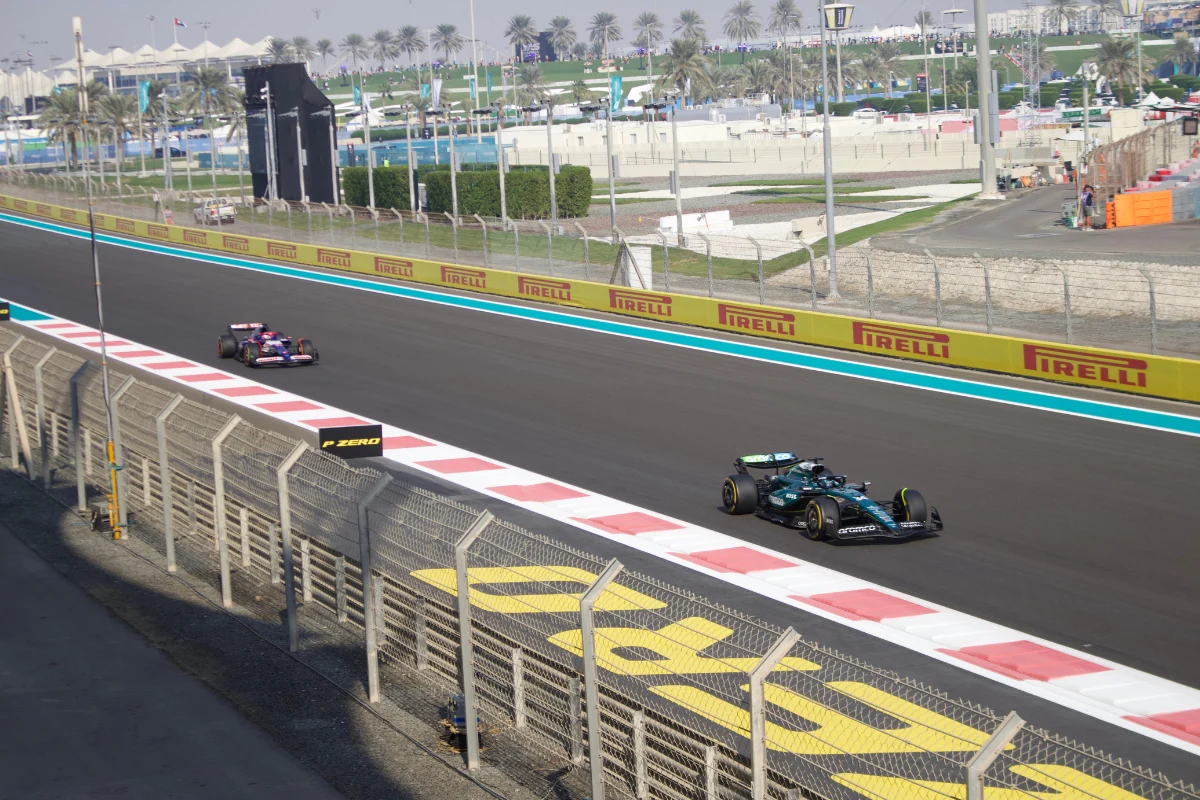
Okay, so what is the DRS and how does it work?
DRS stands for Drag Reduction System. It was introduced in 2011 to solve a huge problem in Formula 1: overtaking.
Surprisingly, this is not so easy.
Let me explain it to you a little more figuratively.
When an F1 car is driving, the air logically glides over the car.
The large rear wing on such a car is positioned steeply in the wind and thus ensures massive downforce (the car is pressed down onto the ground to gain more grip). This ensures that the car is extremely fast in corners.
On long gradients, however, the rear wing also generates enormous air resistance. A bit like a sail, which ensures that the car is slowed down. In addition, the rear wing produces the so-called “dirty air” (it ensures that the air behind it “swirls” and thus becomes “dirty”). A pursuing car loses grip in this air and cannot get close enough to overtake.
And this is exactly where the DRS comes into play: at the touch of a button, the driver folds part of the rear wing flat. This ensures that the air can now flow almost unhindered through the wing instead of bouncing against it. And this, in turn, reduces the air resistance abruptly, the car is slowed down less and “slips through the air more easily. This alone gives it a massive increase in speed – often between 10 and 12 km/h – without any additional engine power. As soon as the driver brakes or presses the button again, the wing closes again.
It’s as if you suddenly move from an upright position to a low position on the handlebars to give the wind less of an attack surface.
When can the DRS be used?
The system is not a permanent turbo, but is subject to strict rules:
- A driver may only activate DRS in a race if he is less than one second behind the car in front. This is measured at a fixed point on the track.
- DRS may not be used everywhere. There are fixed DRS activation zones on every track, mostly on the long straights.
- Race control can deactivate the system at any time – for example in the rain or if there is debris on the track. An open wing in a wet corner would immediately cause the car to take off, as the rear would suddenly break away without the downforce.
Why is the system so controversial?
Although DRS provides more action, there has been criticism since its introduction. Many fans and former drivers such as Juan Pablo Montoya think that it makes overtaking maneuvers look “artificial”.
What are the criticisms of the DRS?
The criticism goes both ways, namely that DRS makes overtaking too easy and sometimes simply doesn’t help at all.
Sometimes the effect of the unfolded rear wing is so strong that a rider easily passes before the braking zone. The “real” wheel-to-wheel duel is lost. And overtaking despite DRS becomes difficult when a so-called “DRS train” develops. In other words, when several cars in a row all have DRS. Because then the advantage is neutralized – nobody can overtake, everyone is stuck.
DRS in practice and qualifying
It is also exciting to know that in practice and qualifying, drivers are always allowed to use DRS in the zones, even if there is no car in front of them. It’s all about getting the absolute fastest lap time out of the car.