Forechecking, face-off, or icing – say what?! Hockey comes with a language of its own, full of quirky terms that sound like they belong in a sci-fi novel rather than on the ice.
Don’t worry, we won’t leave you in the dark (or slipping on the ice). With this glossary, you’ll be an ice hockey insider in no time. Whether you’re sitting in front of the TV completely confused at the first game of your life or want to talk shop at the regulars’ table instead of just pretending you saw the puck – you’ll learn the vocabulary here. So – let’s go! 🏒
Offside also occurs in ice hockey when a player crosses the blue line before the puck is there. Result: stoppage of play.
The first step in the attack. A long, precise pass from your own zone to move the game forward.
The template for the goal. Like the buddy who gives you the perfect conversation starter on a date.
The area where goals are scored (at least if you do it right). Located between the blue line and the opponent’s goal.
The one who attacks. In other words, the guy who tries to shoot the puck into the net.
When your team is not playing at home and facing a hostile crowd.
The guy who drives his opponents crazy with little quips – trash talk, nasty checks, provocative looks. His mission: to upset the other team.

The moment when a striker suddenly realizes that he also has a reverse gear. He runs backwards to help the defense. Rarely seen, but extremely popular!
A shot or pass with the back of the trowel. Works a bit like a backhand in tennis and is often difficult for the goalkeeper to read.
The playing field boundary made of wood or plastic. It ensures that the puck (and the players) stay in play. Caution: Can be damn hard on checks.
An incredibly exciting game with lots of goals and pure action. A real spectacle that metaphorically set the place on fire.
A penalty for the entire team because someone misbehaved or the coach was asleep. The classic: Too many men on ice (too many players on the ice).
A rather unflattering term for a player with an unclean skating style whose ankles bend inwards or outwards in the skates. Usually looks as wobbly as it sounds.
A check from the opponent’s blind spot. Mean, violent and extremely dangerous. In most leagues, this is rightly punished severely.
The goalkeeper’s rectangular, fat-padded glove, with which he casually deflects shots to the side.
The mark on the ice that separates the attacking third from the neutral area. When it comes to offside, this is where it is decided whether an attack is valid or not.
A defender who patrols the blue line and either directs the play from there or fires shots like cannonballs.
When a player recklessly checks an opponent into the boards in such a way that they hit dangerously. Gives a good amount of time in the cooler.
The epitome of ice hockey physics: using your shoulder or hips to fairly (or sometimes not so fairly) push your opponent out of the way.
When your team is short-handed because someone had to go to the penalty box. The lead
The classic playmaker. He rushes up the middle, distributes the pucks and is the engine of the line. Special feature: He also bears enormous responsibility defensively and has to be wide awake at every face-off.
An extremely dangerous and unfair action in which a player attempts to pull or check an opponent below the knees. Anyone who risks the health of their colleagues in this way is immediately sent to the penalty bench.
The classic penalty: A player holds his stick with both hands and pushes the opponent away with the shaft. As the stick does not give way, this is painful and is usually immediately acknowledged by the referee with two minutes.
Probably the most important piece of equipment for every male player. The hard-shell protection protects the “crown jewels” from hard pucks and stray sticks. Once you’ve forgotten it, you’ll never make the same mistake again.
The fine art of puck control. When a player moves the puck so quickly and skillfully that the defender can only see the back of the puck, he has “dangled” it. Also known as a deke (short for decoy). A real highlight for every highlight reel!
A tactical crowbar: instead of playing the puck into the third, it is simply shot deep into the opponent’s corner (“dump”). The forwards then sprint after it (“chase”) to put the opponent under pressure and win the puck back. Often the choice when the neutral zone is tight.
Short for your own defensive third. This is the area between your own baseline and the first blue line. The goal here is to get rid of the puck as quickly as possible (see build-up pass).

When the goalkeeper is taken off the ice to bring on an extra outfield player.
The “protector” of the team. His main task: to protect the top players from rough fouls.
Aggressively tackling the opposition’s defenders to win the puck back early.
The gap between the goalkeeper’s legs. A goal “through the suspenders” is particularly annoying for any goalkeeper.
Yes, in ice hockey you can sometimes let your fist fly. However, there’s at least a five-minute penalty for it.
An unofficial term for when a goal, an assist and a hit happen in one game. Named after the ice hockey legend Gordie Howe.
The goalkeeper.
“The gloves are off!” – The traditional signal that a brawl is imminent.
Three goals in one game by one player. In some halls, hats fly onto the ice – hence the name.
If a player hooks an opponent with his stick to hinder him. Gives two minutes in the penalty box.
A violation of the rules in which the puck is played from one’s own half across the opponent’s goal line without being touched.
A player who hasn’t missed a game for a long time.
A foul that interferes with a player who is not in possession of the puck.
A short, quick shot with the stick to snatch the puck away from the opponent.
A dangerous foul in which the knee is used as a weapon. Is punished very severely by referees.
When the goalkeeper deflects the puck with his foot.
A tactic in which a player deliberately slows down in order to stall for time.
Lateral movements, especially important for goalkeepers to glide quickly from post to post.
A simple goal, often scored with a clever pass.
A pass into the free space in front of a teammate so that he can attack with momentum.
The striker on the left.
The line-up of the team at the start of the match or after interruptions.
Changing players on the fly during the game or changing an entire row.
The changing room.
A puck that is currently not being controlled by anyone.
In the second period, the players’ bench is further away from the defensive third.
Slang for the ice hockey stick.
Colloquial for the helmet.
To score a goal. The term comes from the red light behind the goal.
The strategic allocation of players or lines against certain opponents.
Overcount situation when one team has a player in the penalty box and the other team has more players on the field as a result.
A fancy term for the second third of the game.
Colloquial for gloves.
A ten-minute disciplinary penalty.
A player who delivers at crucial moments. When it counts, he’s on the spot.
A hard worker who works hard in the corners and in front of goal.
The area between the blue lines.
A faceoff in the neutral zone, usually after an icing or when the puck went out of bounds.
A defensive strategy to stop the opponent in the neutral zone.
When the puck is passed between the opponent’s legs.
An attack in which the attacking team is outnumbered by the defenders, e.g. 2-on-1.
Offside. When a player enters the attacking zone before the puck.
A direct shot after a pass without receiving the puck.
Extra time in the event of a draw after regular time.
The flat part of the goalkeeper stick. Useful for defending and stopping passes.
The short-handed game, in which the team tries to survive the penalty time without conceding a goal.
The area next to the pitch where players serve their penalties.
A technique in which the defender pushes the puck away from the opponent with his stick.
Overtime when the opponent is serving a penalty.
Taking the goalie off the ice, usually in favor of an extra field player, to force an equalizer in the final minutes of the game.
A quick shot in which the player brings the puck towards the goal in a flash, without any great sweeping movement.
In ice hockey, refers to the player, often a defenseman, who directs the power play and pulls the strings.
A rebounding puck after the goalkeeper has blocked a shot.
A punishment for excessive physical activity or minor fisticuffs.
A quick attack in the direction of the opponent’s goal, often with superior numbers.
A hard shot in which the player takes a full swing.
The area directly in front of the goal where most goals are scored.
The art of moving the puck quickly and skillfully with the stick. Quasi ice hockey’s answer to dribbling.
In extra time, the next goal immediately decides who wins or loses.
The upper part of the goal, directly under the crossbar. A top shelf shot is difficult to stop.
The trapezoidal area behind the goal in which the goalkeeper is allowed to play the puck. Outside this area, he is prohibited from doing so.
The ball is lost and the puck goes to the opponent.
The team that you expect less from, but that is good for surprises.
Unfair behavior that contradicts the spirit of the game. Will be punished with a penalty – fair play is the be-all and end-all.
The review of disputed match scenes using video technology.
The transparent protective visor on the helmet protects the eyes.
An attempt on goal where the player comes out from behind the goal and tries to push the puck past the post and into the net.
A wrist shot that takes less of a swing than a slapshot, but is more precise and quicker to execute.
The unpredictable player or the element that makes the difference. It’s hard to define, but when it’s there, you notice it immediately.
When a player is checked so hard that his equipment is scattered all over the ice.
The ice machine that smoothes the pitch between thirds. Named after its inventor.
Refers to the different areas of the pitch: attack zone, neutral zone and defense zone. Each has its own strategies and tactics.
At first, ice hockey slang can be as confusing as a puck in a thick snowstorm. But as you can see, behind every “Huh?!” there is usually a very logical explanation or an exciting tradition. With this glossary in your luggage, you’ll be well equipped to not only watch the next game, but to really understand what’s happening on the ice – whether in the rink or in front of the TV.
We hope that we have been able to shed some light on blue lines, penalty times and technical terms. Have you missed a term or stumbled across a new word? Just write to us! We’re constantly expanding our insider knowledge so you can stay on top of the puck.
Have fun at the next game
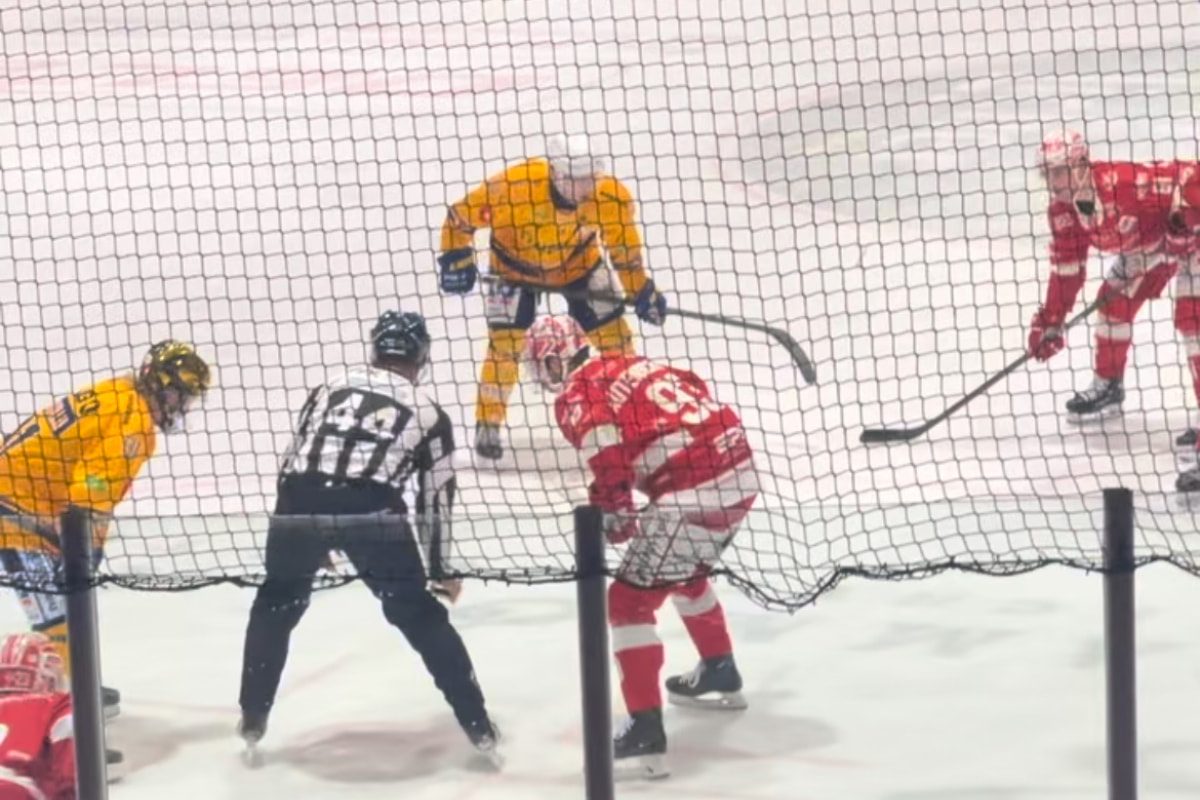
To get started, you should know three terms: Bully (the face-off at the beginning), icing (when the puck is illegally shot across all lines) and offside. If you also know that power play means overtime, you can easily follow every game.
This is due to the roots of the sport in Canada and the dominance of the NHL. Terms such as slot, one-timer or crease are international standards. This means that players and fans around the world understand each other immediately, without having to laboriously translate "goal area" or "direct shot".
The slapshot is a powerful shot with a full lunging motion - maximum power, but harder to aim. The wrist shot comes from the wrist at lightning speed. It may not be as firm, but it is more precise and harder for the goalkeeper to predict.
This describes the two sides of the keeper. The glove side is the side with the catching glove, the blocker side is the side with the stick hand (the flat shin guard on the arm). Forwards often aim specifically at the blocker side because the reaction usually takes a little longer there.
This is the maximum penalty during a match. The player receives a match penalty and has to go to the dressing room immediately. His team usually has to play five minutes short-handed, but the player concerned is completely out for the rest of the game.